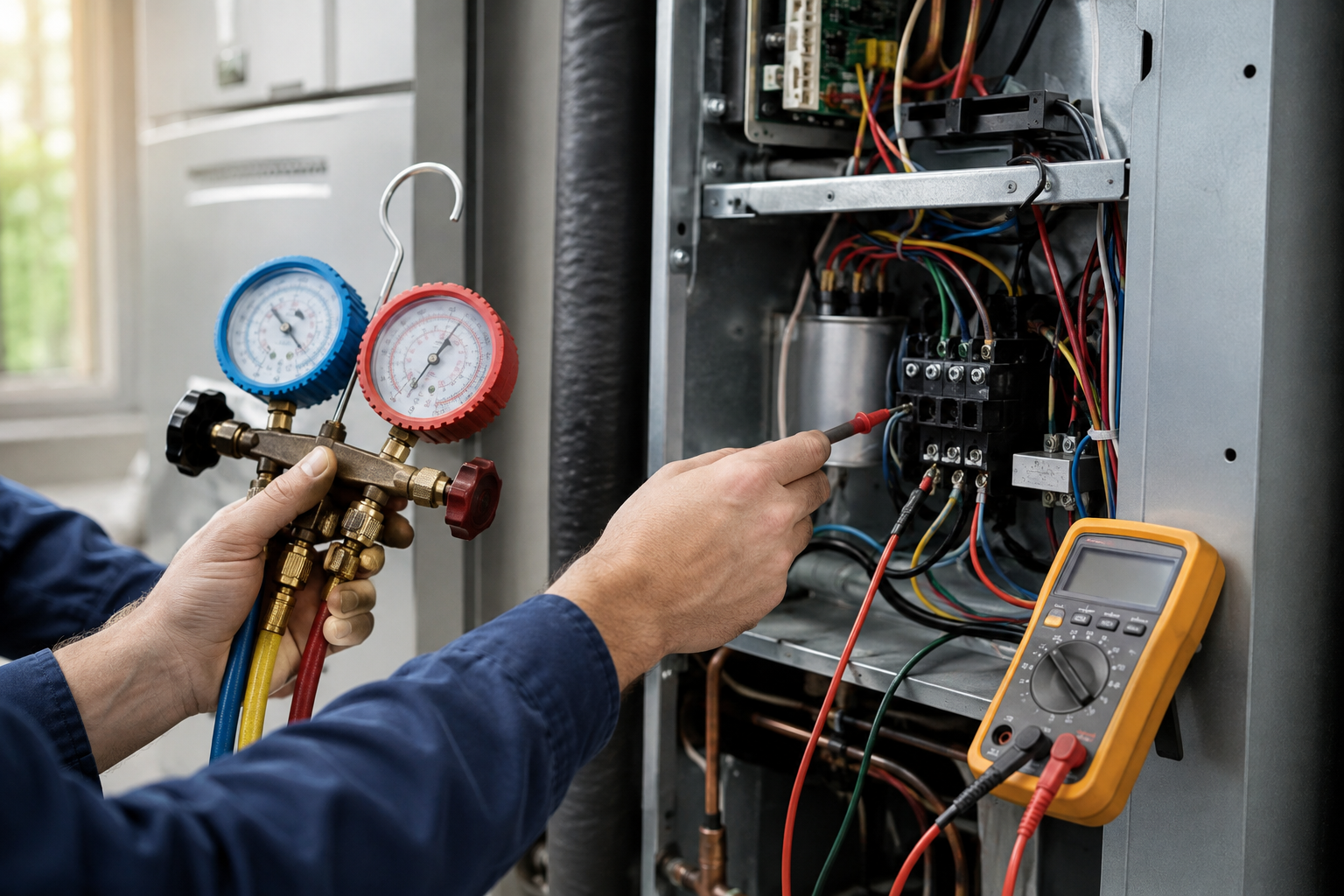
Maintenance should give you information—not just a cleaner coil.
A proper visit helps the system run the way it should, catches developing problems, and gives you a clear picture of its condition before peak heat does the testing for you.
Known problem? Service call. Working system? Maintenance.
A maintenance visit needs a running, working system so operation can be checked before and after cleaning. If you already know the equipment has a problem, choose service or repair—not maintenance.
Choose a service call when
Something is not working correctly.
No cooling, no airflow, or the system will not start
Inside or outside equipment is not running
Water leak, ice, unusual noise, odor, or breaker trip
Intermittent operation or a known part/control problem
Choose maintenance when
The system is running and due for upkeep.
Equipment is operating and cooling normally
It needs routine cleaning, inspection, and performance checks
The goal is prevention, condition reporting, and seasonal care
Routine dirt or drain buildup appears to be the only concern
What happens on arrival: If the system is not operating or has a fault, the visit starts as a service diagnostic so the cause can be found and a repair can be offered. Maintenance can follow after the equipment is running. If the system is otherwise working and only needs routine cleaning or condensate-drain service within the maintenance scope, maintenance may be the right visit.
Simple maintenance pricing
Choose one thorough visit—or keep the full year covered.
Every displayed plan price covers one individual system. Visit count means how often that one system is maintained during the 12-month term—not how many systems are included.
Busy homes, rental properties, short-term vacation rentals, small businesses, pets, or a history of drain problems can justify a closer schedule. These plans follow the same simple prepaid structure.
Each piece of equipment receives the maintenance it needs.
A second, third, or fourth system is separate equipment. One-time visits remain full price; annual-plan customers receive a modest same-property discount on each additional full system enrolled on the same schedule.
Central & packaged systems
One-time: $150 for each system.
First enrolled system: $225 semiannual, $300 triannual, or $400 quarterly.
Each additional enrolled system: $200 semiannual, $270 triannual, or $360 quarterly.
Example: two systems are $300 for one visit or $425 prepaid for two semiannual visits.
Single-zone mini-splits
One outdoor unit with one indoor head counts as one full system and uses the same pricing shown above.
A home with two central systems and one single-zone mini-split has three systems.
Multi-zone mini-splits
A multi-head mini-split still counts as one system. The base system price includes the outdoor unit and first indoor head; each additional indoor head adds a flat $75 to either the one-time service or annual plan price.
Deep cleaning, wash-bag cleaning, blower removal, difficult access, and heavy buildup are quoted separately before work begins.
Simple prepaid schedule. The maintenance completed when the plan starts counts as visit one. Semiannual service returns six months later, triannual service returns every four months, and quarterly service returns every three months. At the anniversary, the customer renews before the next maintenance visit begins a new plan term.
Annual-plan customer benefit. While a two-, three-, or four-visit plan is active, the customer receives 10% off qualifying Sunset Air repair parts and labor plus Supporter Shop merchandise. A one-time maintenance visit does not qualify.
Clear scope. Plan discounts do not apply to the plan price, service-call or diagnostic fees, refrigerant, filters, full-system replacements or installations, permits, taxes, shipping, subcontracted work, or already-discounted packages, and discounts cannot be combined. Deep cleaning and difficult access are quoted separately before extra work begins.
The Sunset standard
A thorough visit, adjusted to the equipment in front of us.
Not every system needs the exact same test on every visit. Measurements are used when they answer a real question, components are cleaned when access and condition allow, and any concern is explained without turning a maintenance into a sales pitch.
Confirm operation before and after service
Document issues that deserve attention
Separate urgent problems from future planning
Leave the equipment area clean
What we check
Four parts of a useful maintenance visit.
The exact scope depends on system type, accessibility, operating conditions, and the equipment manufacturer, but these are the core areas we work through.
Air side & indoor equipment
Inspect the filter and discuss the right replacement schedule
Inspect accessible evaporator-coil and blower conditions
Look for airflow restrictions, dirt buildup, vibration, and cabinet concerns
Check temperature change and overall delivered-air performance
Drainage & moisture
Inspect and clear accessible condensate drain components
Check drain-pan condition and visible signs of overflow
Confirm condensate is moving where it should
Call out algae, insulation, sweating, or water-damage concerns
Electrical & controls
Inspect accessible wiring, terminations, disconnect, and contactor
Test capacitors and review motor/compressor electrical condition
Check thermostat operation and the system sequence
Look for heat damage, corrosion, loose connections, and worn components
Outdoor unit & performance
Clean the outdoor coil when serviceable and accessible
Inspect the fan, compressor area, base, panels, and visible piping
Measure operating temperatures and electrical load as conditions require
Evaluate refrigerant performance when readings and conditions justify it
What maintenance does—and does not—do.
Maintenance is performed on a running system so operation can be confirmed before and after cleaning. It reduces avoidable wear and catches problems earlier, but it does not replace a service diagnostic. Repairs or deep cleaning beyond normal scope are quoted separately before work continues.
Learn about filters
What kind of filter is right for your equipment?
Start with fit and airflow. The best choice depends on your equipment, filter cabinet, and household—not just the number on the package.
Get the size and fit right
Check the equipment instructions and filter cabinet for the correct size and thickness. The old filter can be a useful reference, but it may not be the right one. A filter should fit securely without being forced or leaving gaps.
Match filtration to airflow
MERV describes particle-capture performance. A higher rating is not automatically the best choice for every system. Check your equipment requirements before changing the rating or filter type; Sunset can help assess fit and airflow during maintenance.
Build a routine that fits your home
Follow the filter and equipment instructions, and inspect the filter regularly. Pets, dust, renovation, and heavy system use can change how quickly it loads up. Replace disposable filters; clean reusable filters only as the manufacturer directs.
Make it easier to remember. Choose a filter-check reminder below, then adjust the interval to your equipment and actual filter condition. Reminders do not measure how dirty a filter is.
Maintenance & replacement reminders
A little reminder. A lot less to remember.
Monthly drain cleaning, filter care, system maintenance, UV lamps, and purifier cells—all together. Build a schedule for your equipment and keep the dates handy.
Every monthGive your drain a moment.
A small, regular check-in for your home A/C condensate drain.
Free email reminders—plus calendar downloads.
Choose your dates, confirm the message sent to your inbox, and Sunset will email you when care is due. This free reminder service does not book a visit.
Email service
The Sunset of the Month
Win a free home A/C maintenance or a $150 service credit.
Submit an original Gulf Coast sunset photo. Each month, one standout image lets the winner choose a standard home A/C maintenance or a $150 Sunset Air service credit.
Monthly prizeHome maintenance or $150 creditWinner chooses
Good questions
Maintenance FAQs
Can I get a monthly drain-cleaning reminder?
Yes. Choose monthly drain cleaning in the reminder planner, set your first date, and either turn on free email reminders or download the recurring calendar file. Email reminders begin after you confirm the message sent to your inbox. Use only the cleaning method approved for your equipment and call if the drain is blocked, leaking, or the system is not operating.
Do UV lights and purifier cells all use the same replacement schedule?
No. Record the installed model and last replacement date, then use the manufacturer’s interval or choose a one-time check until Sunset can confirm it. Reminders do not measure remaining lamp output, cell life, or equipment condition.
Can I change or stop my reminders?
Yes. Your private manage link lets you update or remove a saved plan, and every reminder email includes an unsubscribe option. Calendar downloads are separate copies—edit or delete those in your calendar, and check your app’s notification settings.
How often should my home A/C be maintained?
For Gulf Coast conditions, twice per year is a strong schedule for most systems—before the hardest cooling season and again around the heating or shoulder season. Homes with pets, heavy use, construction dust, coastal corrosion, or drainage history may benefit from closer attention.
How do prepaid visits and renewal work?
The visit completed when an annual plan starts is visit one. Semiannual service includes the enrollment visit and another visit six months later. Triannual service returns every four months, and quarterly service returns every three months. Near the 12-month anniversary, renew before the next maintenance visit starts the new annual term.
How are multiple systems and mini-splits priced?
Each plan covers one individual system for the listed number of visits. One-time maintenance is $150 for every central, packaged, or single-zone mini-split system—there is no same-property discount. Additional full systems enrolled on the same annual schedule are $200 semiannual, $270 triannual, or $360 quarterly. A multi-head mini-split still counts as one system: the outdoor unit and first indoor head are included in the system price, and each additional indoor head adds a flat $75 to either the one-time service or annual plan price. Deep cleaning and difficult access are separate.
Who receives the 10% maintenance-customer discount?
Customers with an active two-, three-, or four-visit annual plan receive 10% off qualifying Sunset Air repair parts and labor plus Supporter Shop merchandise during the 12-month plan term. A one-time maintenance visit does not qualify. The exclusions listed with the plan pricing still apply, and discounts cannot be combined.
Do I need to replace the filter before the visit?
No. If possible, leave the current filter in place so its condition can tell us something about airflow, dust load, sizing, and replacement frequency. Have a new filter available if you already supply your own.
Is refrigerant automatically added during maintenance?
No. Refrigerant is not consumed like fuel. If testing indicates a charge problem, the cause and repair options should be discussed before adding refrigerant.
Can I schedule maintenance if my A/C is not working?
No. If the system is not operating, has no cooling, is leaking, frozen, tripping a breaker, or has another known problem, schedule a service call first. The cause must be found and approved repairs completed before a proper maintenance can be finished. If the system is operating and routine dirt or condensate buildup is the only concern, maintenance may be appropriate.
Is marine A/C maintenance the same?
No. Marine systems add seawater flow, strainers, pumps, condensers, vessel power, and confined access. Marine service is scheduled separately based on the equipment and vessel location.